
Policy on Pay Scale Equity
Including a commitment to measurement and elimination of gender pay gaps
Until now, Tashkent State Law University has implemented a number of measures to protect women's rights, increase their influence in society, and ensure equality in every field. In particular, a number of normative documents have been adopted at the university level to end wage inequality in society and to encourage women.
Key Policy Documents
-
1. Gender Equality and Female Empowerment Policy
📄 Download Policy Document -
2. Implementation of Gender Policy
📄 Download Implementation Guidelines -
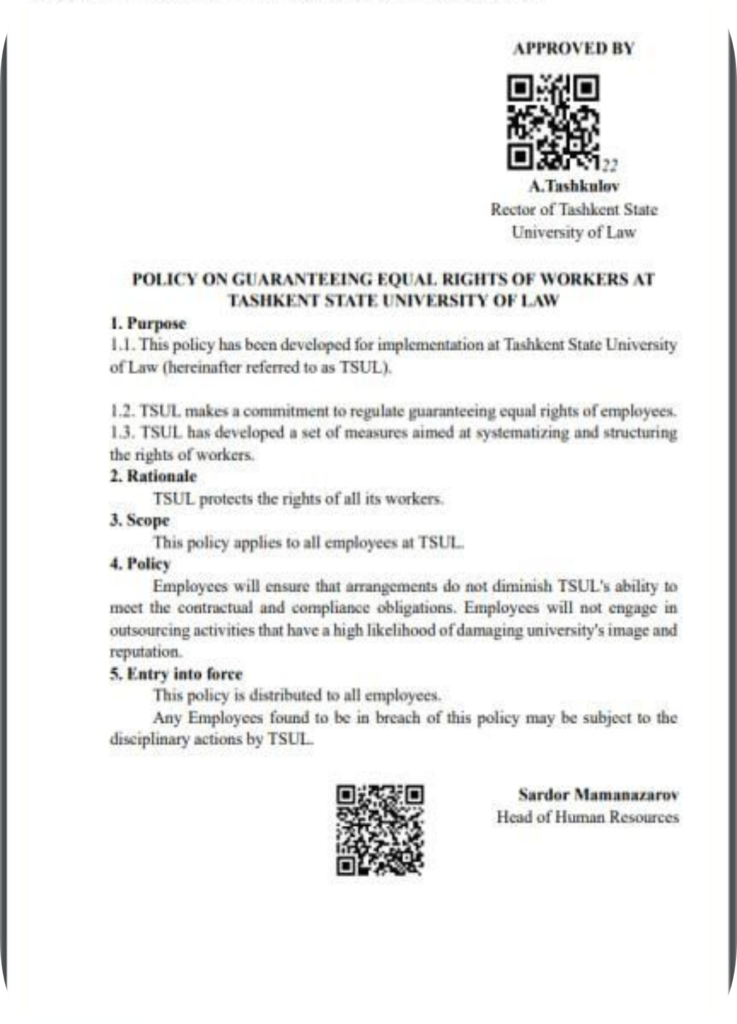
3. Equal Rights of Workers Policy
📄 Download Workers' Rights Policy -
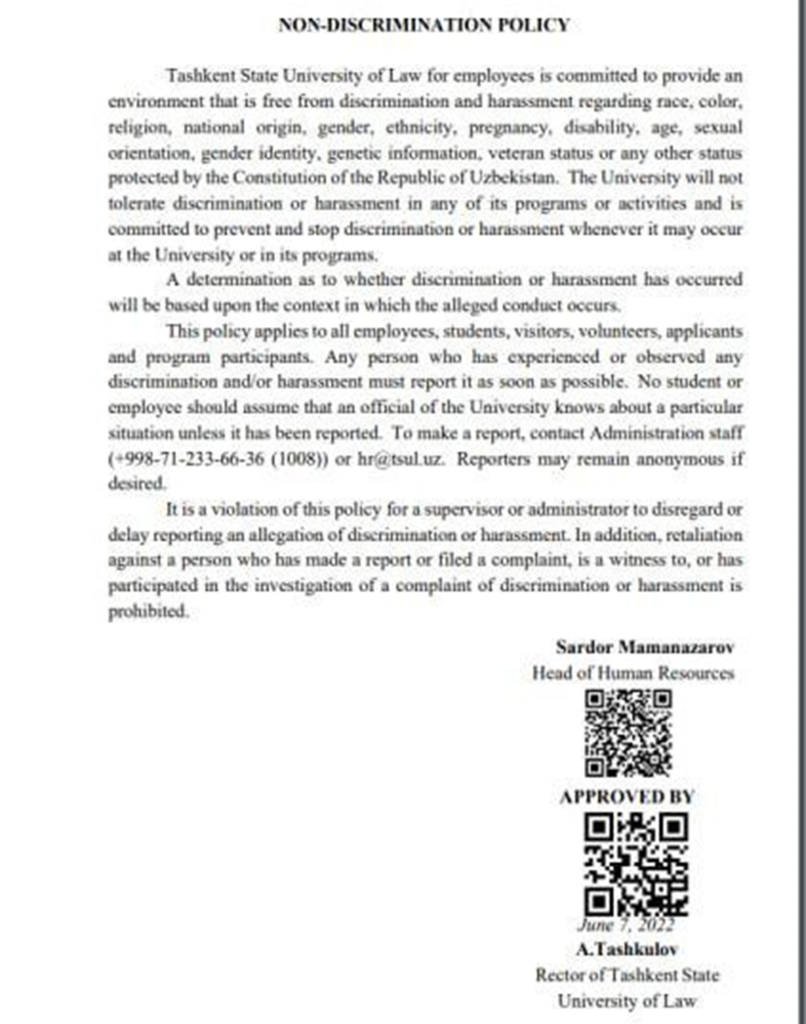
4. Non-Discrimination Policy
📄 Download Non-Discrimination Policy
Pay Scale Equity and Gender Equality Policy
V. Working Process
TSUL's aim is that equal salaries and equal terms of employment shall apply. In the systematic work for equal salaries, analysis of pay differences shall continue to be prioritised, subject to proactive measures and lead to action. The work to create equal terms of employment for the under-represented gender continues.
5.1. Salaries and Terms of Employment
- Salaries are set in accordance with the University's pay policy
- More women are employed as professors
- Fixed-term positions among the under-represented gender in particular are monitored
- Career planning is highlighted in staff appraisals
- The opportunities to combine parenthood and employment at TSUL are taken into consideration
VII. Improving Access to Resources and Services
Women's equal access to productive and financial resources is critical for their empowerment and sustainable and inclusive growth and development. TSUL will ensure that its programmes facilitate equitable access to financial and technical resources and services for all women, regardless of age, disability status, ethnicity, socio-economic status, geographical area or any other condition.
Implementation of Gender Policy
Pursuant to the Law of the Republic of Uzbekistan "On Guarantees of Equal Rights and Opportunities for Women and Men" adopted on September 2, 2019, the university has implemented measures to ensure effective implementation of gender equality principles.
Key Achievements:
- Additional 4% of places allocated for women within state grant admissions (Cabinet of Ministers Decision No. 402, June 23, 2020)
- 20 women admitted on additional state grants (University Rector Order No. 02-134, October 2, 2020)
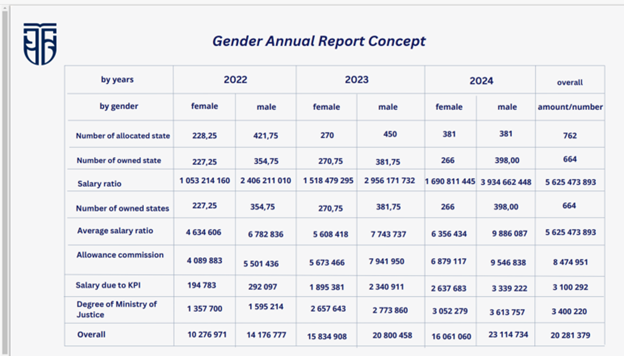
Pay at TSUL is set by position and grade, so men and women in the same grade receive the same salary. The Collective Agreement commits TSUL to equal pay for work of equal value and to eliminating inequality in the pay of women and men (clauses 5.5 and 12.6). |
■Pay structure. Salaries are fixed by position and grade, and allowances are set as a percentage of salary by staff category and by a commission (Rector's Orders No. 08-108 of 16 June 2020 and No. 1745-sht of 28 September 2026), not by sex.
■Collective Agreement 2025–2027. Clause 5.5: under ILO Convention No. 100, work of equal value done by men and women is rewarded equally. Clause 12.6: TSUL and the union undertake to assign responsibility for equal rights of women and men to an authorised official, to ensure equal opportunities in hiring and promotion, and to eliminate inequality in the pay of women and men. The union monitors the pay system and the correctness of pay (clauses 5.2 and 15.7).
■Law. The Labour Code prohibits discrimination in pay and requires equal pay for men and women for work of equal value; Uzbekistan has ratified ILO Convention No. 100 on Equal Remuneration.
■TSUL policies. The Gender Equality and Female Empowerment Policy commits TSUL to equal opportunities and fair remuneration for women. The Rector's order on additional measures for gender policy set up an ombudsman for the rights of students and employees and an advisory council on women's issues.
■Measurement. The Accounting Department calculates the average monthly pay of women and men in six staff categories (8.2.7), giving TSUL and the union the evidence to act on clause 12.6.