
TASHKENT STATE UNIVERSITY OF LAW
Equal Access to Lifelong Learning
| TSUL's Non-Discrimination Policy, approved on 7 June 2022, states that the University "will not tolerate discrimination or harassment in any of its programs or activities", and applies to "visitors, volunteers, applicants and program participants". Together with the Equality, Diversity and Inclusion Policy and two gender policies, it covers every activity in TSUL's 4.3.1–4.3.4 evidence. The University puts these policies into practice through free access, barrier-free buildings and services designed for women, persons with disabilities and people in remote regions. |
4
policies guaranteeing equal access
5 of 5
grounds named by THE covered
Free
every public activity in 4.3.1–4.3.4
Anonymous
reporting, with protection from retaliation
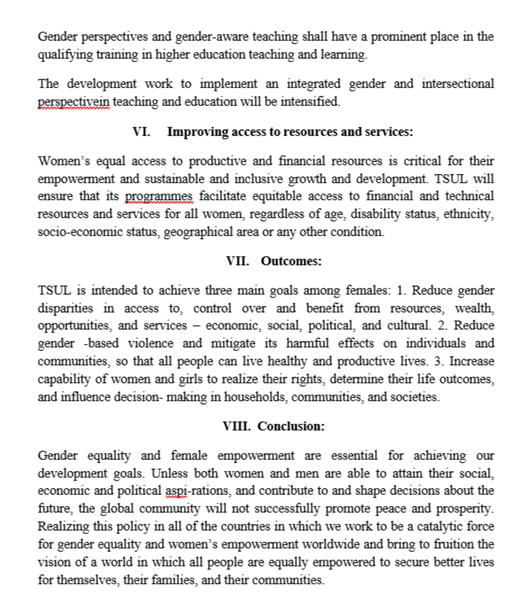
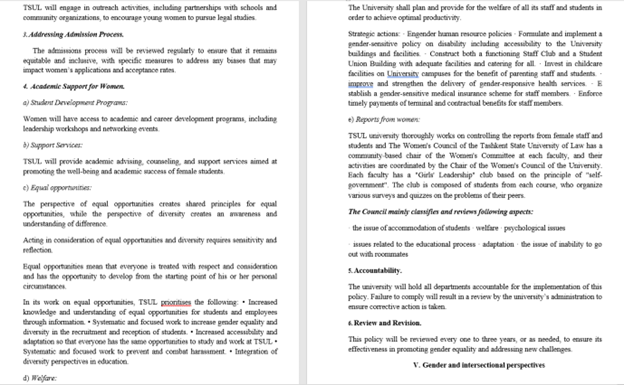
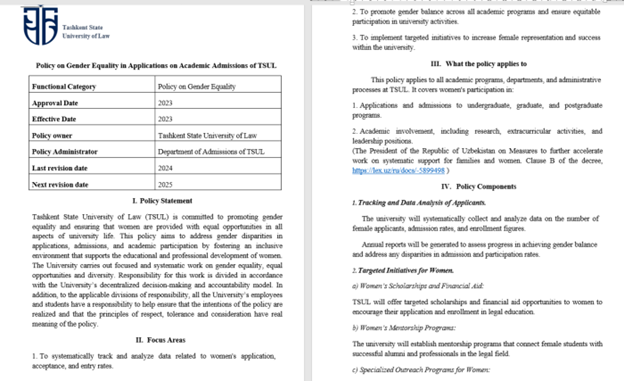
The policy framework
| Policy | Approved | What it guarantees | Document |
|---|---|---|---|
| Non-Discrimination Policy | 7 June 2022 | No discrimination or harassment "in any of its programs or activities"; covers visitors, volunteers, applicants and programme participants | |
| Equality, Diversity and Inclusion Policy | 7 June 2022 | No visitor, student, volunteer or staff member to be discriminated against; reasonable adjustments for disability; complaints open to the public | |
| Gender Equality and Female Empowerment Policy | 2020, revised 2022 | Equal opportunities in teaching, research and knowledge transfer; access for women regardless of age, disability, ethnicity or social status | |
| Order No. 08-242 on gender policy | 11 Dec 2020 | Equal opportunities to study and work regardless of sex; rights ombudsman; women's advisory council |
How the five grounds named by THE are covered
| THE ground | Non-Discrimination Policy | Equality, Diversity and Inclusion Policy |
|---|---|---|
| Ethnicity | "ethnicity", "national origin", "race, color" | "Race", defined to include "ethnic or national origins" |
| Religion | "religion" | "Religion or belief" |
| Disability | "disability" | "Disability"; duty to make "reasonable adjustments" (s. 3.4) |
| Immigration status | "national origin" and "any other status protected by the Constitution of the Republic of Uzbekistan" | "nationality (including citizenship)" |
| Gender | "gender", "gender identity" | "Sex"; reinforced by the two gender policies |
Both policies also protect against discrimination based on age and pregnancy, and the Equality, Diversity and Inclusion Policy adds socio-economic background. Because the Non-Discrimination Policy applies to all programmes and activities and to visitors and programme participants, it covers the public library and online resources (4.3.1), public events (4.3.2), training (4.3.3) and outreach (4.3.4).
From policy to practice: barrier-free access
Access for persons with disabilities is built into TSUL's buildings and services:
- ■
Moving around: ramps at the entrances of academic buildings and dormitories; a lift in Building 4; a wheelchair stair-lift in the underground passage in front of the campus at Amir Temur Square.
- ■
Orientation for visually impaired visitors: tactile guiding and warning tiles in corridors and sanitary rooms, and guiding arrows in the car park and buildings.
- ■
Facilities: separate accessible toilets in academic buildings; designated parking for persons with disabilities in the courtyard of Building 3; rest areas for people with special needs; "without queue" priority-service signs in offices that receive visitors.
- ■
Ground-floor rooms: exam rooms with adapted desks and seating on the ground floor for people with limited mobility.
- ■
Digital access: the University website offers high-contrast, greyscale and inverted colour modes, adjustable font size, an images-off mode and a screen reader. The library holds Braille resources.
Figure 1. Tactile guiding and warning tiles in an academic building. Photo: TSUL campus accessibility record, 2026. |
Figure 2. Wheelchair stair-lift in the underground passage in front of the campus. Photo: TSUL, 2026. |
Figure 3. Accessible toilet in an academic building. Photo: TSUL, 2026. |


Figure 4. Accessibility panel of the TSUL website: colour, contrast and greyscale modes, images-off mode, screen reader and font size. Open tsul.uz |

Sources: TSUL Youth Affairs and Sports Department, information on accessibility measures provided in October 2026; TSUL campus accessibility record and photographs submitted to UI GreenMetric 2026, in which TSUL ranked first in Central Asia; tsul.uz.
Equal access in TSUL's lifelong-learning activities
- ■
No cost, no entry requirements. The library, the e-library, Huquq Maktabi courses, Open Days, Legal Clinic advice and mobile receptions are all free. Library registration needs only an identity document.
- ■
Disability. The Legal Clinic runs a dedicated free service for persons with disabilities. Its 2025 international conference included a session on legal aid for persons with disabilities.
- ■
Gender. The Legal Clinic holds receptions specifically for women, for example in Qo'ng'irot, Karakalpakstan, in September 2026, and TSUL experts train public servants in gender-sensitive service delivery (Fergana, October 2026).
- ■
Language and region. Outreach reached all 14 territorial units in 2025 (the 12 regions, the Republic of Karakalpakstan and Tashkent city). Events in Karakalpakstan are reported in Karakalpak as well as Uzbek, and online resources can be used from anywhere, at any time.
Figure 5. Free legal consultation at the reception for women, Qo'ng'irot, Karakalpakstan, September 2026. Open the original post |
Figure 6. Pupils at a TSUL legal-awareness event in Kegeyli, Karakalpakstan, April 2026. Open the original post |


Sources: Service for persons with disabilities; 2025 conference; Qo'ng'irot; Fergana trainings; Propaganda Train 2025; Kegeyli.
How to raise a concern
Report it. Anyone who experiences or sees discrimination in a TSUL programme or activity can contact the University: +998 71 233 66 36 (ext. 1008) or hr@tsul.uz.
Stay anonymous if you wish. The Non-Discrimination Policy allows anonymous reports.
No retaliation. Retaliation against anyone who reports, complains or takes part in an investigation is prohibited.
Get support. Confidential support is also available through the Trade Union, the Women's Committee and the Students' Association.
Sources
| Source | Publisher | Status |
|---|---|---|
| Non-Discrimination Policy (PDF) | TSUL | Live |
| Equality, Diversity and Inclusion Policy (PDF) | TSUL | Live |
| Gender Equality and Female Empowerment Policy (PDF) | TSUL | Live |
| Order No. 08-242 on gender policy (PDF) | TSUL | Live |
| Admissions and Access Policy (PDF) | TSUL | Live |
| UI GreenMetric 2026 result · tsul.uz | TSUL | Live |
| Accessibility measures; campus accessibility record | TSUL Youth Affairs and Sports Department | Internal |